Most brand owners we talk to have already sorted the obvious things — GSM, colour, packaging. And the one-star reviews still come in, with the same handful of words: loose threads. Fraying. Came apart in the machine wash. Belt unravelling. Snagged pile.
Those reviews almost never mean the fabric was wrong. They mean the stitching was. And a bathrobe has a lot of stitching.
01Your robe is being judged on a bed, next to two others
Online shoppers have learned to use 30-day returns as a fitting room. They order three robes, open the boxes on the bed, keep one and send two back.
That is the real test your product faces. Not a lab report — a side-by-side comparison, by someone actively looking for a reason to return.
A thread hanging from the cuff. A tail at the collar. A belt end already fuzzing. Your robe is out before anyone feels the terry.
And you pay twice: once for the return, and again because the customer who kept the other robe never comes back to yours.
02Two ways a bathrobe fails
Out of the box
Untrimmed thread tails, loose stitches at the collar and cuffs, a belt already fraying at the ends. This is what loses the side-by-side.
After two machine washes
The robe looked fine on arrival. Two machine washes in, threads start unravelling — side seams, armholes, hem, and almost always the belt — and pile loops that were neat in the box come out snagged. This is the one that becomes a written review.
If you've bought or sold bathrobes made in Pakistan before, just throw one in the wash. You'll know what we're talking about.
Towels have the same failure in miniature, at the hems. But a towel has four edges. A bathrobe has side seams, armholes, sleeve seams, cuffs, a collar, pockets, a hanger loop, a label and a belt. Every one is a place for a thread to come loose.
03Why it happens
-
The belt is nobody's priority
In a lot of factories, the robes go through a standard QC process. The belts don't. They go to one person who crops off whatever threads he can see at first glance and moves on. The belt gets less time than any other part of the garment — and it's where the most problems occur.
-
Low SPI on the overlock
SPI — stitches per inch — is how densely a seam is sewn. Many factories run their overlock at 5–6 SPI. Fewer stitches means faster sewing and less thread per robe. It also means each stitch carries more load, so when one goes there's less around it to hold the seam. That's how a seam that looked fine on arrival opens up after a couple of machine washes.
-
Thread chosen on price
Sewing thread is invisible on day one and the first thing to give at the seams. Low-tensile thread passes inspection and fails in the customer's washing machine.
-
Piece-rate trimming
This is the one most buyers never hear about. It's common in this industry to pay thread trimmers per piece. The faster they go, the more they earn. So they cut what they can see in a second and pass the robe on — often to themselves, because the same person also does the final check. Nobody is paid to look twice.
-
Pile loops too long for the GSM
A robe can leave the factory with no snags at all and come out of the machine with pulled loops all over it. That's a design problem. When the pile loops are made too long, the base underneath is less dense, so the loops aren't held tightly and catch easily in the wash. Long loops feel soft in the box — and snag in the machine.


04What it costs the brand
Returns
Every bracketed order that comes back carries shipping both ways, and a robe that often can't be resold as new.
Your rating
A handful of "loose threads" reviews pull the average down — and a lower rating converts fewer of the shoppers who do find you.
The review stays
A review that says "fraying" sits on your listing long after you've fixed the problem. New shoppers read it as if it's about today's product.
The reorder
A robe that unravels doesn't get bought a second time.
05How we build against it at Tulip Towel
We treat this as a design problem, not only an inspection problem — because inspection can only catch what has already gone wrong.
Design stageThe belt seam is folded inward
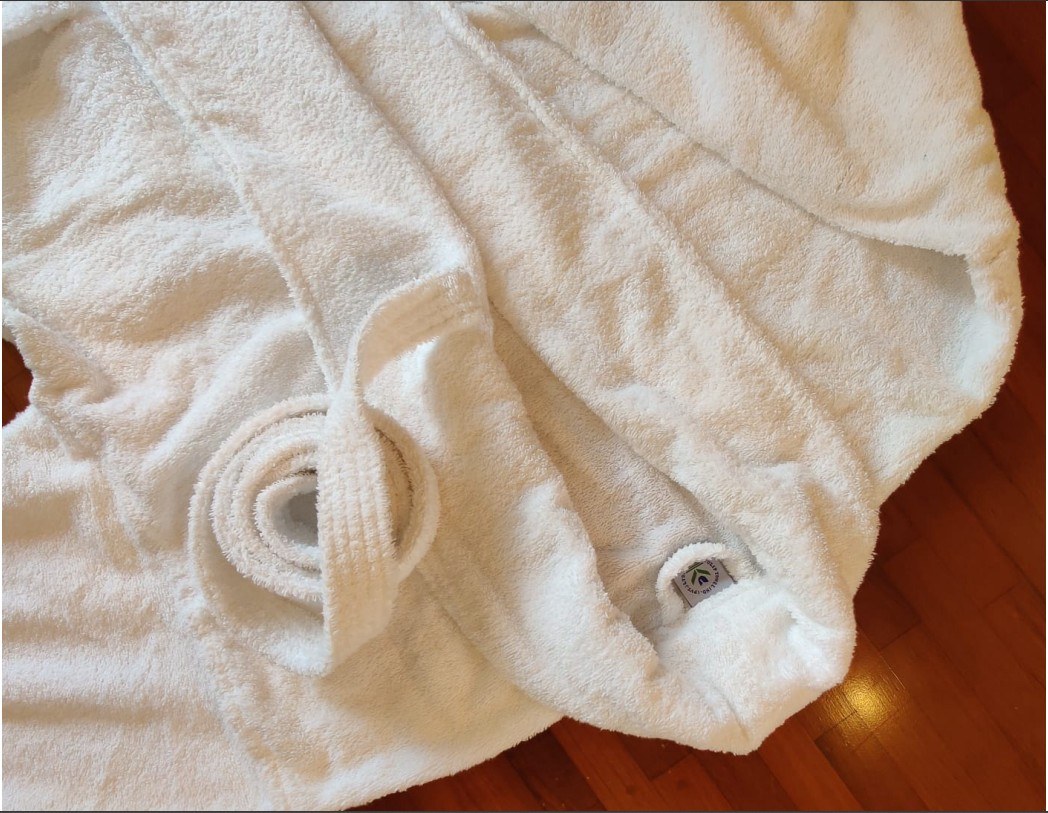
We construct the belt so its seam is folded inwards and stitched over. If threads fray, they stay inside the seam — never visible on the outside. The belt is where most robes fail, so it's where we start.
Pile height engineered to the GSM
Every GSM is engineered on its own. The loops have to be long enough to absorb and feel soft, but not so long that the base loses its density and the loops sit loose enough to snag. We set that balance at the design stage, not after the first complaint.
Stitching stage- 10–11 SPI, not 5–6. We turn our four-thread overlock machines up to the highest stitch density they can sew. That's nearly twice the stitches holding every inch of seam.
- Japanese Juki machines. We specifically use Juki for this work because of their stitch quality.
- High-tensile sewing thread, mostly imported. Chosen for strength, not for what it saves per robe.
Two people, two jobs
We run multi-stage thread trimming, and the person who trims is never the person who does the final QC. Our trimmers are paid a day salary, not by the piece — so nobody on that line earns more by going faster.
It costs us more, which is why it's often skipped. It's also why a robe leaves our floor without the thread tail that would have lost it the comparison on someone's bed.
06Check your own robes: the 8 places loose threads hide
Use this on your current stock or your next set of supplier samples. Turn the robe inside out first — most of these are on the inside.
- The belt. Start here; it's where most problems are. Check both ends and run the full length through your fingers. Is the seam folded inward, or is the edge exposed?
- The collar. The front collar edges, and where the collar joins the body.
- Label and hanger loop. Tucked behind the neck, so tails get left here.
- Inner side seams. The seams joining the front panels to the back panel, full length.
- Armholes. All the way around, inside.
- Inside of the sleeve. The full length of the sleeve seam.
- Inside of the cuffs. Fold the cuff back and look.
- Bottom hem. The full circumference, inside and out.
Then put one sample through two machine washes and check the same eight places again — and look over the body for snagged loops. A robe that passes out of the box but fails after washing has a stitching or pile problem, not a trimming problem.
Take the checklist to your next sample review
The eight points on one printable page, with pass/fail boxes for out of the box and after washing.
Download the checklistYou'll also get Sourcing Notes, our occasional email on how towels and robes are built. Unsubscribe any time.
Already getting scathing reviews? Send them to us.
If your bathrobe reviews mention loose threads, fraying or seams coming apart, send us:
- Your product link
- Your 1–3 star reviews (copied or screenshots)
- Photos of the problem areas, if you have them
Shayan Naseem reads every one himself. He's a second-generation textile manufacturer who came up through retail, trained in product development and textile engineering, and is a qualified marketplace listing consultant. He knows how a robe is built, and how a listing ranks and converts.
He'll match each complaint to the construction failure behind it — belt, overlock, thread or trimming — and tell you what would need to change in the next production run. The review is free, with no obligation to order. If you do go on to order with us, your listing's performance becomes a shared objective: we're only as good as the reviews your customers leave.
If you're struggling with reviews like these, talk to us about building a robe strong enough to earn ratings above 4.5 stars.
Frequently asked questions
Why do bathrobes have loose threads?
Usually because thread trimming was rushed — often by trimmers paid per piece — and nobody separate checked the robe afterwards. The collar, cuffs, label area and belt ends are the most common spots.
Why does a bathrobe belt fray?
Belts often skip the QC the robe gets, and many are built with the seam edge exposed. A belt whose seam is folded inward and stitched over keeps any fraying inside the seam, out of sight.
What is SPI in sewing?
Stitches per inch — how many stitches sit in one inch of seam. Many bathrobe factories overlock at 5–6 SPI; we run 10–11. Higher SPI spreads the load across more stitches, so the seam holds better through repeated washing.
Why does bathrobe pile snag after washing?
The pile loops are too long for the GSM. Longer loops mean a less dense base, so the loops aren't held tightly and catch in the machine. Each GSM needs its loop height engineered — long enough to absorb and feel soft, short enough to stay put.
Why do bathrobe seams come apart after washing?
Low SPI, low-tensile thread, or both. These problems are invisible on arrival and show up after a couple of machine washes, which is why a washed-sample check matters before you approve production.