GSM Series · Part 1 of 2
What GSM Really Tells You About a Towel — and What It Doesn't
GSM is the first number on every towel spec sheet and the most misread. Here's what grams per square metre actually measures, how to match it to where the towel will be used, and the trap of assuming heavier always means better.
Key takeaways
| What GSM is | Grams per square metre — a density figure for the fabric, not the weight of the finished towel. |
|---|---|
| The three tiers | Lightweight (300–400 GSM), mid-weight (400–600 GSM), and luxury (600 GSM and above). |
| Match to use | Choose GSM by environment and laundry capacity, not by chasing the highest number. |
| The common mistake | Higher GSM is not automatically better — heavier towels cost more, dry slower, and strain commercial laundries. |
| GSM isn't the whole story | Yarn type, loop construction, and the measurement method all change a towel of the same GSM. |
What GSM actually measures
GSM stands for grams per square metre. It measures how much the towel fabric weighs for a given area — in other words, its density. The higher the GSM, the more cotton is packed into the same surface, which is what gives a towel its thickness, absorbency, and weight in the hand.
It helps to remember that GSM is a density figure, not the weight of the towel you'll hold. To get the actual weight of a finished towel, you multiply its dimensions by its GSM:
Width (m) × Length (m) × GSM = Weight in grams
Example: 0.70 × 1.40 × 500 = 490 grams
For a sourcing manager, GSM is the fastest way to compare towels at a glance — but it works best when every other variable (yarn, size, construction) is held equal. As soon as those differ, two towels with the same GSM can be very different products.
The three GSM tiers
Most towels fall into three broad weight bands. Each band suits a different balance of plushness, durability, drying time, and cost.
| Tier | GSM Range | Character | Typical Use |
|---|---|---|---|
| Lightweight | 300–400 GSM | Thin, fast-drying, economical | Gym, travel, pool, budget hospitality, kitchen |
| Mid-weight | 400–600 GSM | Balanced softness and absorbency | Everyday home use, standard hotel and retail programs |
| Luxury | 600 GSM and above | Plush, heavy, highly absorbent | Premium hotels, spas, high-end retail |
The mid-weight band, 400–600 GSM, is the workhorse of the industry — it covers the majority of hotel and retail towel programs because it balances guest experience against laundry cost and drying time.
Matching GSM to the job
The right GSM is the one that fits the environment the towel will live in. A towel that feels perfect in a spa suite can be the wrong choice for a busy guest house with high laundry turnover. Use this as a starting point:
| Setting | Suggested GSM | Why |
|---|---|---|
| Kitchen / tea towels | 300–400 GSM | Light and quick-drying for constant reuse |
| Gym, pool, travel | 300–450 GSM | Compact, fast-drying, easy to launder in volume |
| Standard hotel bathrooms | 450–550 GSM | Good guest feel without overloading commercial laundry |
| Home bathrooms | 450–600 GSM | Soft and absorbent, durable through frequent washing |
| Luxury hotels & spas | 600 GSM and above | Maximum plushness for a premium guest experience |
Before locking a GSM, confirm one practical point: your laundry operation can handle the weight. Higher-GSM towels hold more water, take longer to dry, and add load weight to every wash cycle — a real cost in a high-turnover property.
The "heavier is better" mistake
The most common error in towel buying is treating GSM as a quality score — assuming that a higher number automatically means a better towel. It doesn't. A higher GSM means a denser, heavier towel, and that comes with trade-offs:
- Longer drying times, in both the guest bathroom and the laundry
- Higher cost per piece and higher shipping weight
- More strain on commercial laundry capacity and energy use
- A risk of musty odour if heavy towels aren't dried thoroughly
A 700 GSM towel is not "better" than a 500 GSM towel — it's a different tool for a different job. The skill in sourcing is matching the weight to the use, the brand positioning, and the laundry reality, rather than defaulting to the heaviest option on the table.
What GSM can't tell you
GSM is a useful tier marker, but it's only one line on the spec sheet. Two towels at the same GSM can feel and perform very differently depending on three things GSM never captures:
- Yarn type. Combed cotton removes shorter fibres for a smoother, stronger, lower-linting towel. Zero-twist and low-twist yarns change softness and absorbency. Bamboo and TENCEL blends behave differently again — all at the same GSM.
- Loop construction. Loop height and density affect how plush and absorbent a towel feels, independent of its weight.
- How the GSM was measured. The same towel can show two different GSM numbers depending on the method used to weigh it — which is exactly where many quote comparisons go wrong.
This is also where verification matters. The yarn and finishing behind a GSM figure are where quality is genuinely made or lost, so it's worth confirming a supplier's claims against recognised standards rather than the spec sheet alone. Our towels are certified to OEKO-TEX® Standard 100 (tested free from harmful substances), ISO 9001 (quality management), and amfori BSCI (social compliance), and we source through the Better Cotton Initiative.
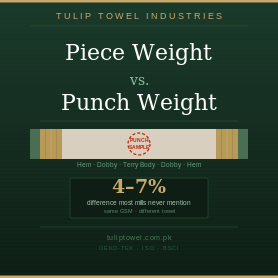
That measurement point is big enough to deserve its own guide. In Part 2 of this series, we break down piece weight versus punch weight — the 4–7% gap that makes two "500 GSM" quotes mean different things.
Frequently asked questions
GSM stands for grams per square metre. It measures the density of the towel fabric — how much cotton is packed into a given area — which determines the towel's thickness, absorbency, and weight.
Most hotels use 450–550 GSM for everyday bath towels, balancing guest comfort against laundry cost and drying time. Luxury hotels and spas often move to 600 GSM and above for a plusher feel. The right weight depends on your brand positioning and your laundry capacity.
No. A higher GSM means a denser, heavier, more absorbent towel — but it also dries slower, costs more, and puts more load on commercial laundries. The best GSM is the one that matches where the towel will be used, not simply the highest number available.
Tulip Towel Industries manufactures across the full range — from lightweight 300–400 GSM towels through to luxury weights of 600 GSM and above — in 100% combed cotton, zero-twist, bamboo, and TENCEL blends. We can match a GSM to your specification and price point.
No. Two towels of the same GSM can differ in yarn type, loop construction, and the method used to measure the GSM. These factors change how a towel feels and performs, so GSM should be read alongside the full specification — not on its own.
Sourcing towels and not sure which weight fits?
We manufacture across every GSM tier in 100% cotton, zero-twist, bamboo, and TENCEL — OEKO-TEX® Standard 100, amfori BSCI, and ISO 9001 certified, sourcing through the Better Cotton Initiative, with GSP+ duty-free access to the EU. Tell us the use and the price point, and we'll recommend the right specification.
Tulip Towel Industries Pvt Ltd · Karachi, Pakistan · All GSM figures stated on piece weight unless otherwise specified. OEKO-TEX® Standard 100 · ISO 9001 · amfori BSCI certified · Better Cotton Initiative member.